We also provide information on waste reduction, correct behaviour in nature, recycling and food waste – all to promote a more mindful use of what nature provides.
Landscape, nature and environment
Development goals of the Dolomites Region Seiser Alm
Key priorities include preserving this unique natural landscape, using resources carefully, expanding public transport and infrastructure, fostering responsible overall economic development, strengthening local economic cycles and preserving the distinctive character of the area.
- Environment
- Economy & Tourism
- Society
- Culture
-
Ecological developmentWe are strongly committed to encouraging our guests to travel by bus and train. The region’s well-developed transport network makes it easy to enjoy a car-free holiday.To reduce plastic use, we inspire visitors to drink the excellent tap and spring water available locally. Refillable water bottles can be topped up at drinking fountains.
We also provide information on waste reduction, correct behaviour in nature, recycling and food waste – all to promote a more mindful use of what nature provides. -
Sustainability in Economy & TourismAll measures taken in the Dolomites Region Seiser Alm in accordance with the tourism development strategy should also benefit future generations.
Accommodation providers can obtain the South Tyrol Sustainability Certification, demonstrating their forward-looking and responsible approach. The numerous awareness-raising events contribute to the forward-looking development of the Dolomites Region Seiser Alm. -
Social developmentNumerous volunteers and community members dedicate their time to the fire brigade, the White Cross and local associations, supporting social wellbeing. These organisations are equally committed to inclusion and equal opportunities, ensuring that people with disabilities are naturally integrated into the community.
Other important topics include accessibility, the organisation and support of of events and charitable initiatives. -
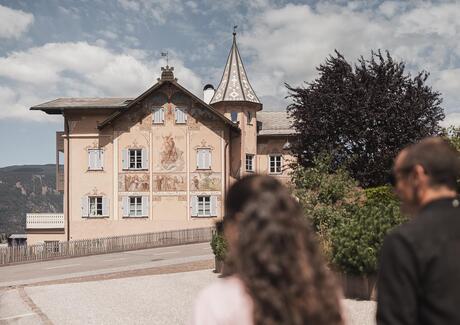
Cultural developmentFor us, it is of fundamental importance to preserve the cultural uniqueness of the Dolomites Region Seiser Alm. By keeping traditions alive (celebrating festivals, honouring customs and ensuring that traditional recipes and dishes are not forgotten) we pass on their cultural value to future generations.
Local dialects and multilingualism are also part of our heritage and must not be lost. Cultural assets, especially historic buildings, require careful maintenance and protection.
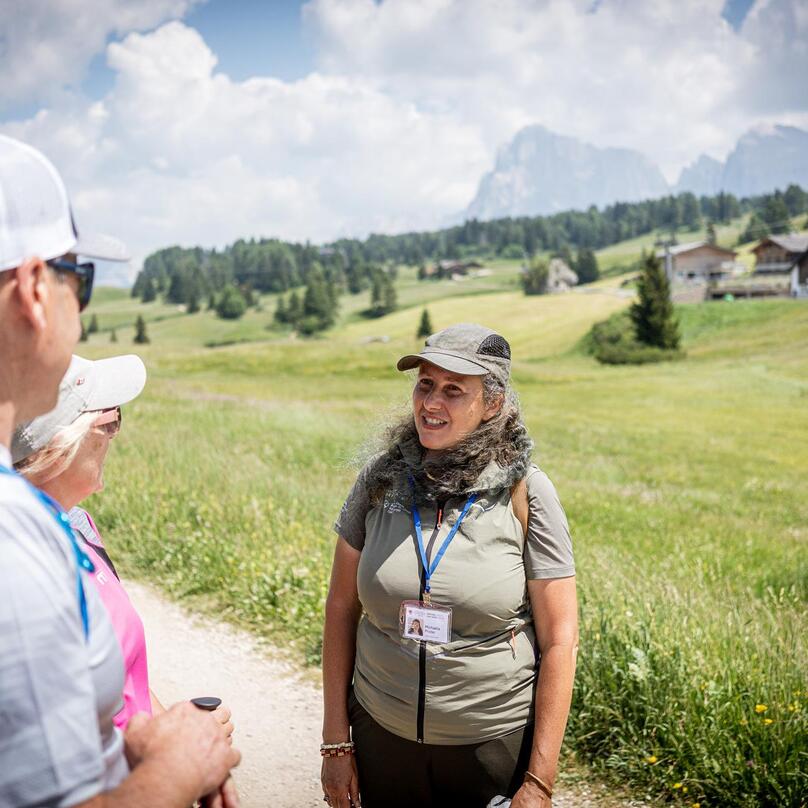
The Dolomites Region of Seiser Alm is a unique natural and living environment. To ensure that future generations can continue to experience this landscape in all its diversity, three South Tyrol Alto Adige Rangers have been active in the area since summer 2026.
From May until the end of September, the Rangers can be found on the Seiser Alm/Alpe di Siusi, in Seis am Schlern/Siusi allo Sciliar and Völser Weiher lake. They answer visitors’ questions, raise awareness about respectful behaviour in nature, provide information about the special features of the area and observe visitor behaviour. Their aim is to raise awareness of the importance of protecting this unique Dolomites landscape and to foster a respectful coexistence between people and nature.
Our Rangers look forward to meeting you and are happy to provide information, answer questions and offer guidance.
- Local project
- Project Development and New Partner
- Requirements for participation
- Bike2Work 2026
- Reduction in CO₂ emissions
-
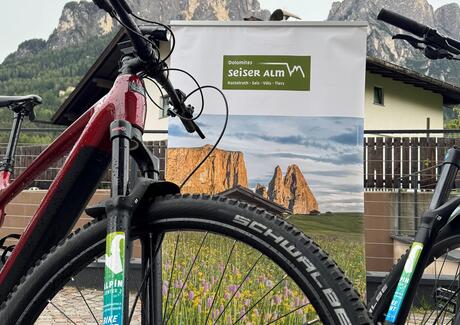
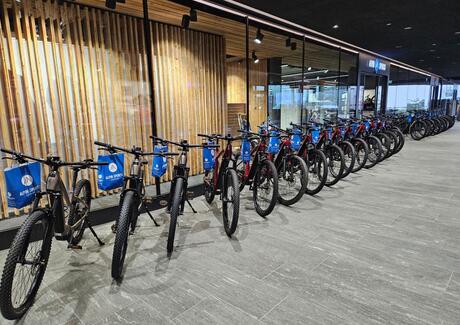
Bike2Work is a project initiated and funded by the operators of the mountain lifts in the Seiser Alm ski area. Developed in cooperation with the South Tyrol Institute for Applied Ecology and Seiser Alm Marketing, the project promotes car-free mobility and is now entering its fourth year.
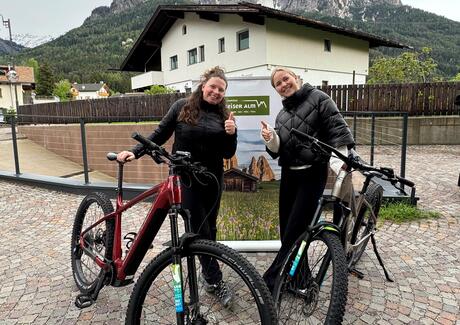
As part of the project, local residents are provided with free e-bikes for their everyday journeys, encouraging a long-term change in mobility habits. Bike2Work specifically supports people who consciously choose to switch from their car to an e-bike for their commute to work. -
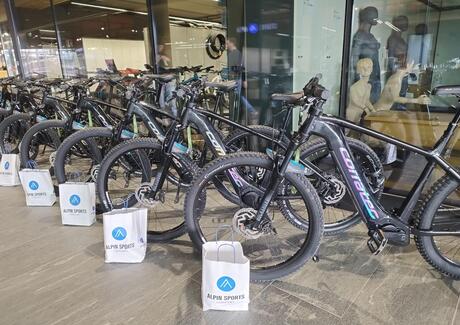
The project was launched in May 2023 with 10 e-bikes. Due to the high demand in its first year, the operators of the Seiser Alm mountain lifts purchased 15 additional e-bikes, bringing the total number available for the project to 25 in 2024. In 2025, the offer was expanded to 30 e-bikes.
In 2026, Raiffeisenkasse Kastelruth–St. Ulrich is also joining the project, supporting it with 10 additional e-bikes. This means that a total of 40 e-bikes are available to the local population this year. The project is an important step towards promoting cycling mobility and encouraging people to consciously choose to leave their cars at home in the future. -
To apply for an e-bike as part of the project, the following criteria must be met:
• A minimum distance of 2 km to the workplace, or a daily distance of at least 5 km if more than two trips are made per day
• Use of the bicycle for commuting to work on at least three days per week
• Residence in one of the following municipalities: Kastelruth, Völs, Tiers or St. Ulrich -
Start of the fourth roundYou’ve always wanted to go to work by e-bike? This year again, you have the opportunity to do so! Take this chance to do something good for your health and switch from your car to an e-bike! Register starting from 25 February 2026 via our application form and receive your e-bike from May 2026 onwards.
Registration for 2026 is now closed.
The event will take place again in the summer of 2027! -
Measurable success
Bike2Work is gaining momentum: While there were only 11 participants in the pilot phase, there were already 30 participants in 2025.
The number of kilometers cycled has increased by 335 %, and at the same time, emissions savings have risen by 330 %—to a total of 4.59 tCO₂eq.
This saving is roughly equivalent to the average per-capita CO₂ footprint of a person worldwide.Kilometres travelled per participant
- 573,18 km per partecipant
1 tonne of CO₂ is emitted when...
- 605,52 km per partecipant
- 915,43 km per partecipant
…an airplane can fly approximately 3,800 km (e.g., the route from Frankfurt to Lisbon).
…a train can travel approximately 80,000 km.
…a 45 m² living space can be heated for one year.
To absorb 1 tonne of CO₂, a beech tree needs approximately 80 years.
Here’s how you can help protect nature in the Dolomites:
- Treat flora and fauna – and people – with respect.
- Take your rubbish back down into the valley.
- Plan your tours carefully and according to your fitness level.
- Stay on marked routes.
- Follow rules and operating times in ski and hiking areas.
- Buy local products and travel as environmentally friendly as possible.
- Experience nature directly rather than only through your camera lens.
- Calculate your CO₂ footprint
- Climate change & climate adaptation
- Possible scenarios
- Challenges bring new opportunities
-
Did you know?It’s surprising how much climate-relevant CO₂ is generated during your journey to the destination and throughout your entire holiday. Calculate your personal footprint and find out how many emissions you generate. The calculation takes less than a minute.
-
The greatest challenge of our timesClimate change is undeniable and cannot be stopped. It is already happening, and its effects can also be felt in our Dolomites region. Its impacts influence travel behaviour in both summer and winter and are changing the needs of our guests. Tourism offers, infrastructure and tourism development as a whole increasingly need to be adapted to the unavoidable consequences of climate change.
-
What will things look like in 2060?Forecasts indicate that temperatures will continue to rise and that outdoor activities will therefore be possible earlier in the year: for example, an extended spring hike as early as the beginning of March instead of April, or a summit hike in summer in the early morning rather than later in the day. Climate scenarios also show that the number of days with frost, which is necessary for technical snowmaking, will decrease. As a result, the economic viability of technical snowmaking will become an increasingly greater challenge in the future. Winter, with temperatures below 0°C and snowfall, will start increasingly later, shifting towards the end of December or the beginning of January. This will also affect the length and timing of the ski season on the Seiser Alm.
-
Adapting to the circumstancesBased on climate change projections, the situation in our destination was analysed together with local stakeholders (interest groups). The interviews and workshops identified various areas for action that will need to be prioritised in the future, particularly due to the uncertain conditions for winter sports: cycling and hiking, adapting the seasons and the winter tourism sector as a whole.